


iPhone 15 to iPhone 18: What Changes with an Upgrade?
Content Team, Jio Mart • 23 Oct 2026
Quick Overview
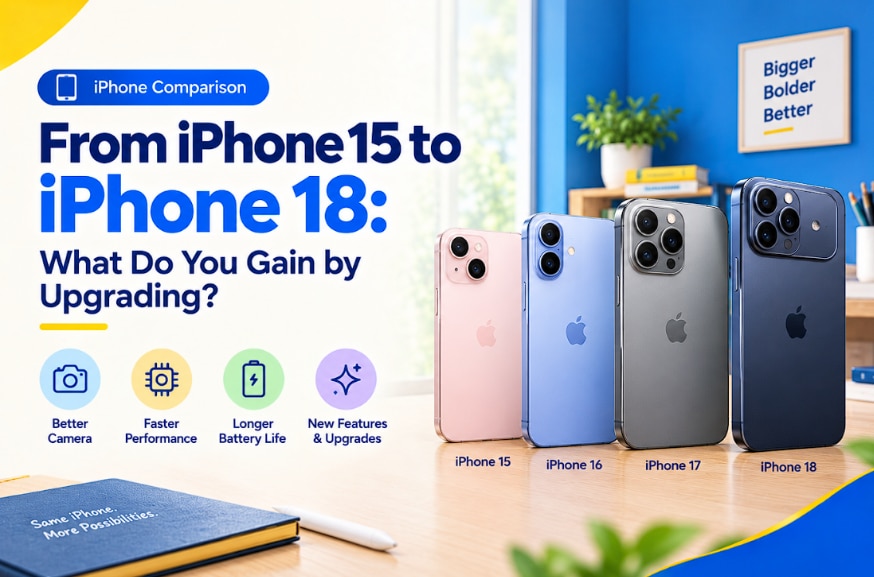
- iPhone 15 vs iPhone 18 Pro covers three iPhone generations of change, not a small step
- Key takeaways: the iPhone 15 already offers a 6.1-inch display, A16 Bionic chip, and up to 20 hours of video playback, while the iPhone 18 Pro brings a new A20 Pro chip, a variable-aperture camera system, and full Apple Intelligence support
- Storage now starts at 256GB on the Pro rather than 128GB, and pricing scales with each generation and storage tier
Jumping from iPhone 15 to iPhone 18 Pro is a genuinely different decision to a single-generation upgrade. Three years of chip, camera, and software improvements add up in ways that are easy to underestimate.
This guide breaks down exactly what changes and whether it's worth making the leap now.
iPhone 15 vs iPhone 18 Pro: Features Comparison
|
Specification |
iPhone 15 |
iPhone 18 Pro |
|
Processor |
A16 Bionic, 6-core CPU, 5-core GPU |
A20 Pro, 6-core CPU with next-gen vapour chamber (up to 40% faster graphics than iPhone 17 Pro), dual 16-core Neural Engine, new C2 modem |
|
Display |
6.1" Super Retina XDR OLED, 60Hz, 460ppi, 2,000 nits peak outdoor |
6.3" Super Retina XDR OLED, ProMotion up to 120Hz |
|
Camera |
48MP Main (ƒ/1.6) + 12MP Ultra Wide (ƒ/2.4) + 12MP 2x Telephoto; 12MP TrueDepth front |
48MP Fusion Main with variable aperture (ƒ/1.48–ƒ/4.0) + 48MP Ultra Wide (ƒ/2.2) + 48MP Telephoto (100/200mm, 4x/8x, ƒ/2.8); 18MP Center Stage front; up to 8x optical-quality zoom |
|
Battery |
Up to 20 hours video playback |
Fast charging up to 50% in around 15 minutes (Apple hasn't published a separate video-playback figure for the standard Pro) |
|
Design |
Aluminium, Ceramic Shield front, colour-infused glass back |
Aluminium unibody, Ceramic Shield front and back, four colours: Burgundy, Glacier, Silver, Black |
|
Software |
iOS 17 at launch, no Apple Intelligence support |
Siri AI and full Apple Intelligence support, including Clean Up, Image Playground, Writing Tools and Visual Intelligence |
|
Storage options |
128GB, 256GB, 512GB |
256GB, 512GB, 1TB, 2TB |
This iPhone 18 Pro vs iPhone 15 table shows just how much ground three generations cover, even though the two phones share a broadly similar footprint and screen size.
Performance and Processor: How Much Could Change?
iPhone 15 vs iPhone 18 Pro Performance Comparison
The A16 Bionic in the iPhone 15 remains capable for everyday use, but it lacks Apple Intelligence support entirely, a limitation that becomes more noticeable as more iOS features lean on on-device AI processing.
The iPhone 18 Pro's A20 Pro chip brings a meaningful generational leap, with a next-generation vapour chamber pushing graphics performance up to 40% faster than even the iPhone 17 Pro, plus a dual 16-core Neural Engine offering twice the on-device AI compute. The new C2 modem also brings noticeably better cellular reliability and uploads up to 50% faster than the previous C1X modem in select markets. If you've felt your iPhone 15 slow down handling newer iOS features, this is where the difference shows up most.
Display and Design: What's Expected to Be Different?
Display Size and Visual Experience
The iPhone 15's 6.1-inch display is sharp and colour-accurate, but it caps at a standard 60Hz refresh rate. Scrolling and animations feel noticeably less fluid compared to phones with adaptive refresh technology.
The iPhone 18 Pro moves up to a 6.3-inch Super Retina XDR display with ProMotion running up to 120Hz, for noticeably smoother scrolling and a display that feels far more responsive to touch.
Design Changes From iPhone 15 to iPhone 18 Pro
The iPhone 15's aluminium and glass construction has held up well, but three generations of refinement bring subtle but real improvements to in-hand feel and durability. The iPhone 18 Pro carries an aluminium unibody with Ceramic Shield on both the front and back, and launches in four finishes: Burgundy, Glacier, Silver and Black: a noticeably different palette from the iPhone 15's 2023 colour lineup.
iPhone 15 vs iPhone 18 Pro: Who Should Upgrade?
If your iPhone 15 still feels fast for daily use, camera improvements alone may not justify the upgrade cost. But if you've noticed battery degradation after several years of daily charging cycles, or you rely on newer Apple Intelligence features that your iPhone 15 simply can't run, the case for upgrading becomes much stronger.
Heavy photographers and video creators will notice the biggest jump, since three generations of camera sensor and processing improvements compound significantly. Casual users focused mainly on messaging, browsing, and social media may find the iPhone 15 still serves them well for another year.
Conclusion: Should You Upgrade From iPhone 15 to iPhone 18 Pro?
The jump from iPhone 15 vs iPhone 18 Pro represents one of the more substantial upgrade gaps in recent iPhone history, spanning chip architecture, display technology, and a full generation of Apple Intelligence support that the iPhone 15 was never built to run.
If budget allows and you use your phone heavily for photography, gaming, or AI-assisted features, the upgrade is genuinely worth it. If your iPhone 15 still meets your daily needs comfortably, there's no urgency, but know that the gap will only continue widening from here. Secure your iPhone 18 Pro or iPhone 18 Pro Max when pre-bookings go live on September 12 at 5:30 PM, with retail sales and deliveries starting September 18 at 8:00 AM.
FAQs
Is it worth upgrading to iPhone 18 Pro?
Yes, particularly if you use your phone heavily for photography, gaming, or Apple Intelligence features. The A20 Pro chip, variable-aperture camera system, and 120Hz display over the iPhone 15 are substantial enough to justify the cost for most active users.
What is the difference between iPhone 15 and 18 Pro?
The main differences span three generations of chip architecture (A16 Bionic to A20 Pro), a display refresh rate upgrade to 120Hz ProMotion, a meaningfully upgraded camera system with variable aperture and 8x optical-quality zoom, and full Apple Intelligence support that the iPhone 15 doesn't have at all.
Should I upgrade from iPhone 15 to 18 Pro?
If your iPhone 15 feels slow, your battery has degraded noticeably, or you want access to Apple Intelligence features, upgrading makes sense. If it still meets your daily needs comfortably, there's no pressure to switch right away.