


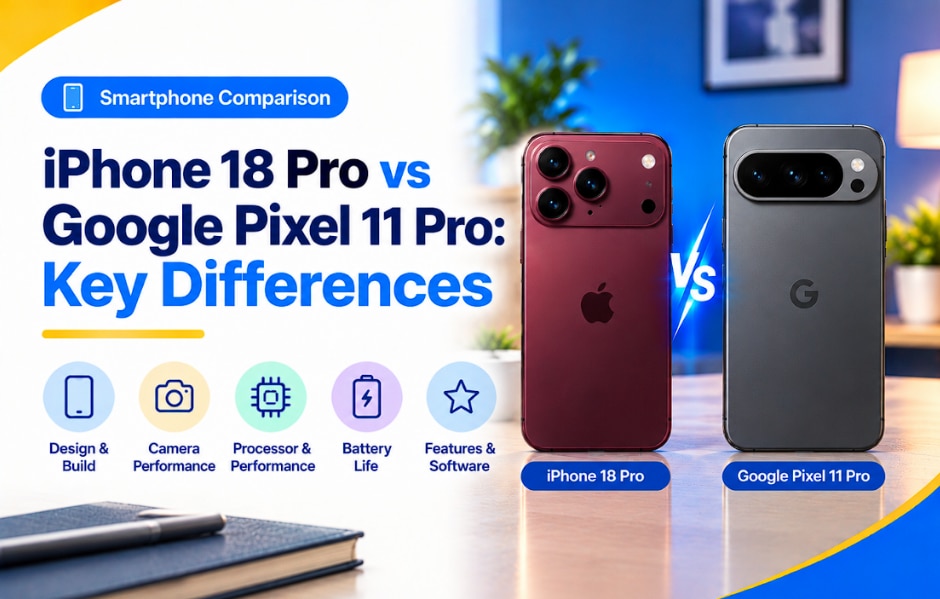
iPhone 18 Pro vs Google Pixel 11 Pro: Key Differences
Content Team, Jio Mart • 23 Oct 2026
Quick Overview
- iPhone 18 Pro vs Google Pixel 11 Pro comes down to camera philosophy, chip architecture, and how much you value Google's AI-first approach versus Apple's ecosystem consistency
- Key takeaways: the Pixel 11 Pro brings a 2nm Tensor G6 chip with vapour chamber cooling, a 6.3-inch LTPO display peaking at 3,600 nits, and a triple 48MP-plus camera system with genuine 5x optical zoom
- The iPhone 18 Pro counters with its own A20 Pro chip, a 6.3-inch ProMotion display, and a 48MP Fusion camera system with a variable-aperture main lens and up to 8x optical-quality zoom
- The iPhone 18 Pro also goes further on storage, topping out at 2TB versus the Pixel's 1TB ceiling
Deciding between the iPhone 18 Pro and the Google Pixel 11 Pro means weighing two genuinely different approaches to what a flagship phone should prioritise.
Google leans hard into on-device AI and computational photography. Apple leans into ecosystem polish and long-term consistency. Both are excellent phones, but they reward different priorities.
iPhone 18 Pro vs Google Pixel 11 Pro: Complete Specs Comparison
|
Specification |
iPhone 18 Pro |
Google Pixel 11 Pro |
|
Processor |
A20 Pro, 6-core CPU, next-gen vapour chamber (up to 40% faster graphics than iPhone 17 Pro), dual 16-core Neural Engine, new C2 modem |
Google Tensor G6 (2nm node) with Titan M3 security coprocessor, integrated vapour chamber cooling |
|
Display |
6.3" Super Retina XDR, ProMotion up to 120Hz |
6.3" Super Actua LTPO OLED, 1280x2856 (495ppi), 1–120Hz, up to 3,600 nits peak, Gorilla Glass Victus 2 |
|
Camera |
48MP Fusion Main with variable aperture (ƒ/1.48–ƒ/4.0) + 48MP Ultra Wide (ƒ/2.2) + 48MP Telephoto (100/200mm, 4x/8x, ƒ/2.8); 18MP Center Stage front; up to 8x optical-quality zoom |
Rear: 50MP Main (ƒ/1.68) + 48MP Ultrawide (ƒ/1.7) + 48MP Telephoto (ƒ/2.8, 5x optical); Front: 42MP Ultrawide (ƒ/2.2) with Dual AF |
|
Battery |
Fast charging up to 50% in around 15 minutes (Apple hasn't published a separate capacity or video-playback figure for the standard Pro) |
4,850mAh |
|
Charging |
Up to 50% in around 15 minutes with a compatible power adapter |
30W wired (55% in ~30 mins), 25W wireless Qi2, reverse wireless charging |
|
Storage |
256GB / 512GB / 1TB / 2TB |
256GB / 512GB / 1TB UFS 4.0, 16GB LPDDR5X RAM |
|
Software |
Siri AI and Apple Intelligence, including Clean Up, Image Playground, Writing Tools and Visual Intelligence |
Android with Gemini AI integration |
|
Connectivity |
Wi-Fi 7, Bluetooth 6, 5G, eSIM |
5G (sub-6 & mmWave), Wi-Fi 7, Bluetooth 6.0, UWB, Satellite SOS, NFC, USB-C 3.2 |
This Google Pixel 11 Pro vs iPhone 18 Pro breakdown shows how far Google has pushed its silicon this generation, moving to a 2nm process with genuinely improved thermal management.
Performance and Software: iPhone 18 Pro vs Pixel 11 Pro
iPhone 18 Pro vs Pixel 11 Pro: Key Performance Differences
The Tensor G6's move to a 2nm manufacturing process, paired with an integrated vapour chamber, should let the Pixel 11 Pro sustain peak performance longer during demanding tasks like gaming or 4K video editing, without the throttling that has affected some earlier Tensor chips.
The iPhone 18 Pro brings its own step up in chip efficiency and sustained performance, building on the strong groundwork the iPhone 17 Pro series laid with hardware-accelerated ray tracing and effective thermal design. Both phones should handle everyday multitasking comfortably, with the real difference showing up during extended, demanding sessions.
iOS vs Android: Software Experience and Features
The Pixel 11 Pro's biggest advantage remains Google's AI integration. Gemini runs natively across the interface, with features like Magic Cue, Call Assist, and Circle to Search working seamlessly across apps rather than feeling bolted on.
The iPhone 18 Pro continues Apple's tightly controlled, consistent approach to iOS, with Apple Intelligence expanding its feature set. If you value long-term interface familiarity and deep integration with other Apple devices, iOS remains the safer, more predictable experience.
Camera: iPhone 18 Pro vs Google Pixel 11 Pro
Photography: Which Phone Is Better for Photos?
The Pixel 11 Pro's triple camera system is genuinely well-rounded, with a 50MP main sensor, a 48MP ultrawide, and a 48MP telephoto offering real 5x optical zoom. Google's computational photography has long excelled at natural-looking low-light shots and accurate skin tones.
The iPhone 18 Pro's camera system builds on the strong triple-lens setup from the iPhone 17 Pro line, with improved low-light processing and refined colour science. For anyone comparing iPhone 18 Pro vs Pixel 11 Pro on pure photo quality, both phones are genuinely capable, with Google typically favouring brightness and detail, and Apple typically favouring natural tonal balance.
Video Recording and Camera Features Compared
The Pixel 11 Pro's 42MP ultrawide front camera with Dual AF is a notable upgrade for anyone who shoots frequent video calls or vlogs, since autofocus consistency matters more here than raw resolution.
The iPhone 18 Pro carries forward Apple's strength in video capture, particularly around stabilisation and colour consistency across clips shot at different times of day. For Pixel 11 Pro vs iPhone 18 Pro video work specifically, your existing editing workflow (Apple's ProRes ecosystem versus Android-native tools) may matter more than the raw specs.
Display, Battery and Design: What Are the Key Differences?
The Pixel 11 Pro's 6.3-inch LTPO display peaks at an impressive 3,600 nits, making outdoor visibility genuinely excellent even in direct sunlight. Its 4,850mAh battery, paired with 30W wired and 25W wireless charging, should comfortably cover a full day of moderate to heavy use.
The iPhone 18 Pro offers its own meaningful display and battery gains over the iPhone 17 Pro, though Apple's charging speeds have historically trailed Google and Samsung's fastest options. Design-wise, both phones favour durable glass construction, with the Pixel 11 Pro using Gorilla Glass Victus 2 specifically for drop resistance.
iPhone 18 Pro or Google Pixel 11 Pro: Which One Should You Choose?
If you want the most capable native AI experience, a genuinely versatile zoom camera, and Google's typically faster software update pace, the Pixel 11 Pro is a strong pick this generation. It particularly suits anyone who already lives inside Google's ecosystem, Gmail, Google Photos, and Drive.
If you're invested in Apple's ecosystem, with a Mac, iPad, or Apple Watch already in daily use, the iPhone 18 Pro's tight integration is hard to pass up. It also suits anyone who prioritises long-term interface consistency over frequent AI feature experimentation.
Conclusion: Should You Choose the iPhone 18 Pro or Google Pixel 11 Pro?
The decision between iPhone 18 Pro vs Google Pixel 11 Pro depends on individual usage needs. Choose the Pixel 11 Pro if AI-driven features, zoom versatility, and Android's flexibility matter most to you. Choose the iPhone 18 Pro if ecosystem consistency and Apple's refined software experience matter most day-to-day.
Both phones represent genuinely strong flagship choices this year. The right one depends on which ecosystem and priorities fit how you actually use your phone. Ready to upgrade? Pre-book the iPhone 18 Pro from September 12 at 5:30 PM, with sales and deliveries starting September 18 at 8:00 AM.
FAQs
Which phone is better, the Pixel 11 or the iPhone 18?
It depends on your priorities. The Pixel 11 Pro offers stronger native AI features and slightly faster wired charging, while the iPhone 18 Pro offers tighter ecosystem integration, a wider optical-quality zoom range, and a 2TB storage option Google doesn't match.
Which is better, iPhone or Google Pixel?
Neither is universally better. iPhone suits users already invested in Apple's ecosystem and who value long-term interface consistency. Google Pixel suits users who want the latest AI features and prefer Android's flexibility.
Should I buy an iPhone or Google Pixel?
Buy an iPhone if you already own other Apple devices or prefer iOS's tightly controlled experience. Buy a Google Pixel if you want Gemini's AI features built in natively and a camera system tuned for computational photography.