


iPhone Fold vs Samsung Galaxy Z Fold 8: Key Differences
Content Team, Jio Mart • 23 Oct 2026
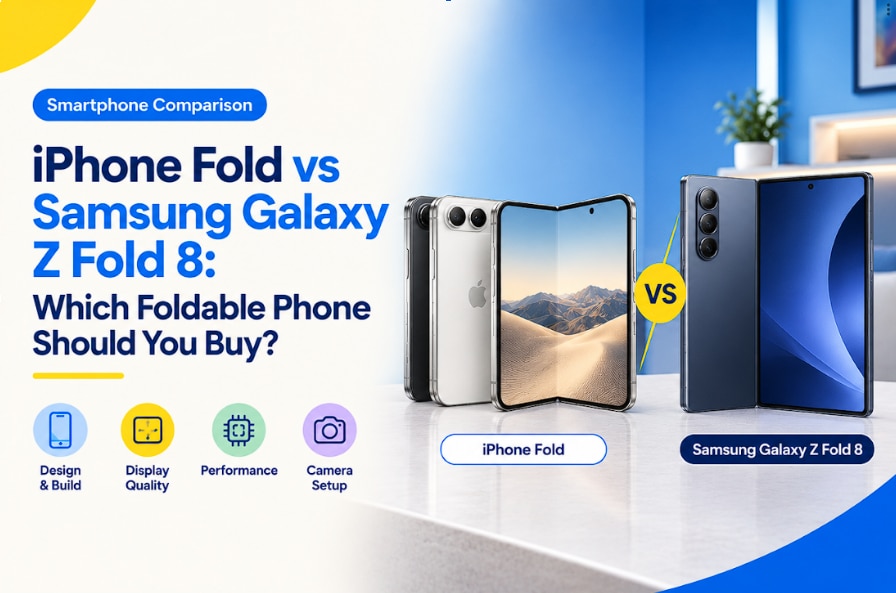
Quick Overview
- Samsung Galaxy Z Fold 8 vs iPhone Duo pits Samsung's redesigned passport-style foldable against Apple's first entry into the category
- Key takeaways: the Galaxy Z Fold 8 brings a 7.6-inch main display, Snapdragon 8 Elite Gen 5 chip, and dual 50MP cameras, while the iPhone Duo counters with its own 7.6-inch folding display, A20 Pro chip, and a 48MP Dual Fusion camera system with a genuine telephoto lens
- Storage tiers scale similarly across both, with pricing rising accordingly at each step, though the iPhone Duo starts considerably higher
- Pre-orders for the iPhone Duo open on October 16 at 5:30 PM, with retail sales and deliveries starting October 23 at 8:00 AM.
Choosing between the iPhone Duo vs Z Fold 8 means picking between two very different approaches to foldables. Samsung has iterated on this form factor for eight generations. Apple is starting fresh, but with the benefit of watching the category mature first.
iPhone Duo vs. Samsung Galaxy Z Fold 8: Specifications Compared
|
Specification |
iPhone Duo |
Samsung Galaxy Z Fold 8 |
|
Processor |
A20 Pro (6-core CPU, dual 16-core Neural Engine, hardware-accelerated ray tracing) |
Snapdragon 8 Elite Gen 5 for Galaxy |
|
Main display |
7.6" Super Retina XDR OLED, 1878x2670 at 430ppi, ProMotion up to 120Hz, 3,000 nits peak |
7.6" Dynamic AMOLED 2X, 120Hz, 3,000 nits peak |
|
Cover display |
5.4" Super Retina XDR, 1398x2034 at 460ppi |
5.45", 10:16 aspect ratio |
|
RAM |
Not officially disclosed by Apple |
12GB (256GB/512GB), 16GB (1TB) |
|
Camera |
48MP Dual Fusion: 48MP Main (ƒ/1.6) with 12MP optical-quality 2x Telephoto, 48MP Ultra Wide (ƒ/2.2, 120° FOV) |
50MP Wide + 50MP Ultra Wide, no dedicated telephoto, up to 10x digital zoom |
|
Battery |
Up to 24 hours typical use; up to 44 hours video playback (outer display) |
4,800mAh, up to 26 hours video playback |
|
Design |
Titanium foldable design, Ceramic Shield 2 front, Ceramic Shield back, IP68 rated |
Flex Titanium hinge layer, Armour Aluminium frame, Gorilla Glass Ceramic 3 front, IP48 rated |
|
Weight |
254g (open) |
201g |
|
Storage |
256GB, 512GB, 1TB, 2TB |
256GB, 512GB, 1TB |
Design, Dimensions and In-Hand Feel
Samsung's Galaxy Z Fold 8 takes a genuinely new approach this generation, moving to a wider, shorter "passport-style" shape at just 201 grams, making it the lightest Fold Samsung has built. The Flex Titanium layer beneath the display and the redesigned Armour FlexHinge are aimed squarely at addressing the durability concerns that have followed foldables since the category began, though its IP48 rating only covers limited dust and splash resistance.
The iPhone Duo is noticeably heavier at 254 grams and leans on the titanium and Ceramic Shield 2 materials Apple already established across its Pro lineup, now applied to a folding chassis. Where Apple pulls ahead on paper is durability: an IP68 rating means the iPhone Duo can handle submersion up to 6 metres for 30 minutes, a meaningfully higher bar than the Z Fold 8's IP48 rating.
Display Upgrades That Matter in Daily Use
The Galaxy Z Fold 8's 7.6-inch main display, paired with a genuinely usable 5.45-inch cover screen, means you're rarely forced to unfold the device just to check a notification or reply to a message. Peak brightness hitting 3,000 nits also makes outdoor visibility a non-issue.
The iPhone Duo matches that with its own 7.6-inch inner Super Retina XDR display (1878x2670 at 430ppi) and a 5.4-inch outer display (1398x2034 at 460ppi), both running ProMotion up to 120Hz and hitting the same 3,000 nits peak outdoor brightness. Apple's inner display also uses a nano-texture finish, which should help with glare and fingerprint visibility, especially around the crease: likely the biggest differentiator in daily use once real-world reviews land.
RAM and Real-World Performance
Samsung's Snapdragon 8 Elite Gen 5 for Galaxy chip, paired with up to 16GB of RAM on the top storage tier, is tuned for genuinely heavy multitasking, running three to five apps side by side without slowdown.
Apple doesn't publish RAM figures for the iPhone Duo, but the A20 Pro chip's 6-core CPU, 7-core GPU with Neural Accelerators, and dual 16-core Neural Engine suggest strong sustained performance, including hardware-accelerated ray tracing that Samsung's chip doesn't specifically call out. Foldables place unique demands on thermal management because the larger internal display drives higher power draw, so real-world multitasking comparisons matter more than raw specs here.
Battery Life and Charging Improvements
The Galaxy Z Fold 8's 4,800mAh battery delivers up to 26 hours of video playback, respectable for a foldable but not class-leading against Samsung's own non-folding flagships.
The iPhone Duo runs on dual built-in batteries rated for up to 24 hours of typical use, and up to 44 hours of video playback on the outer display or 31 hours on the inner display: comfortably ahead of the Z Fold 8's video playback figure. Charging is rated at up to 50% in around 20 minutes with a 60W-capable USB-C adapter, or 30 minutes using a 35W adapter with a MagSafe Charger.
Connectivity and Wireless Standards
Both phones support current 5G, Wi-Fi 7, and Bluetooth standards as a baseline for a 2026 flagship foldable. The iPhone Duo specifically includes the Apple N1 wireless chip, Bluetooth 6, Thread networking, a second-generation Ultra Wideband chip, and NFC with reader mode, alongside dual eSIM support (no physical SIM tray). Samsung's Z Fold 8 also includes UWB and satellite-adjacent features depending on region.
iPhone Duo vs. Samsung Galaxy Z Fold 8: Camera Comparison
Main Camera and Low-Light Performance
Samsung's dual 50MP setup, paired with its ProVisual Engine, handles low light competently, though the Z Fold 8 notably skips a dedicated telephoto lens this generation, a trade-off for its slimmer profile.
The iPhone Duo's 48MP Dual Fusion system includes a 48MP Main camera (26mm, ƒ/1.6) with sensor-shift optical image stabilisation, plus a 48MP Ultra Wide (13mm, ƒ/2.2, 120° field of view). Backed by the Photonic Engine, Deep Fusion, and Smart HDR 5, it carries over the same low-light processing Apple built out across its Pro line.
Zoom, Portrait and Travel Photography
Without a telephoto lens, the Galaxy Z Fold 8 relies on digital zoom up to 10x, which won't match dedicated optical zoom hardware for distant or travel photography specifically.
The iPhone Duo has a genuine edge here: its Main camera doubles as a 12MP optical-quality 2x Telephoto (52mm, ƒ/1.6), giving a 4x optical-quality zoom range in total, plus digital zoom up to 10x. For travel or portrait shooting where optical zoom actually matters, that's a real advantage over Samsung's digital-only approach.
Video Recording for Content Creators
Samsung's Dual Recording feature, letting you capture two angles simultaneously across the cover and main screens, is a genuinely creator-focused addition this generation, alongside AI tools like My FanCam for auto-cropping group footage.
The iPhone Duo answers with its own Dual Capture feature, shooting up to 4K Dolby Vision at 30fps across both cameras simultaneously, plus 4K Dolby Vision recording up to 120fps on the Main camera and Cinematic mode up to 4K Dolby Vision at 60fps. Apple's ecosystem-first editing tools (Final Cut, ProRes-adjacent workflows) may appeal more to creators already invested in Apple's software.
Should You Buy the iPhone Duo Now or Wait?
If you're already inside Apple's ecosystem and have been waiting specifically for an Apple foldable, buying now makes sense: the IP68 rating, genuine optical zoom, and matching display specs make this a genuinely capable first-generation device. If the ecosystem doesn't matter and price matters more, the Galaxy Z Fold 8's eight generations of refinement and notably lower starting price carry real weight.
Conclusion
Samsung Galaxy Z Fold 8 vs iPhone Duo ultimately comes down to ecosystem loyalty and how much you value Samsung's longer foldable track record against Apple's promise of a more refined, crease-minimised first attempt. Both are genuinely premium devices; neither is a clear winner for everyone.
FAQs
How does the iPhone Duo price compare with the Galaxy Z Fold 8?
The Galaxy Z Fold 8 starts at Rs. 1,79,999 in India for the 256GB variant and goes up to Rs. 2,34,999 for the 1TB variant. The iPhone Duo starts considerably higher, at Rs. 2,99,000 for 256GB, rising to Rs. 3,24,900 (512GB), Rs. 3,74,900 (1TB) and Rs. 4,49,900 (2TB).
Which phone has the better foldable display, iPhone Duo or Galaxy Z Fold 8?
Both offer a 7.6-inch main display with 3,000 nits of peak brightness and a 120Hz refresh rate. The iPhone Duo's inner display adds a nano-texture finish and a marginally sharper 430ppi resolution, while its 5.4-inch cover display edges out the Z Fold 8's 5.45-inch panel on pixel density at 460ppi.
How does the iPhone Duo camera compare with the Galaxy Z Fold 8 camera?
The Galaxy Z Fold 8 uses a dual 50MP setup without a dedicated telephoto lens and relies on up to 10x digital zoom. The iPhone Duo's 48MP Dual Fusion system includes a genuine 12MP optical-quality 2x Telephoto lens for a 4x optical-quality zoom range, giving it a real edge for travel and portrait photography specifically.