


LED vs QLED vs OLED TVs: Key Differences Explained
Content Team, Jio Mart • 21 Oct 2026
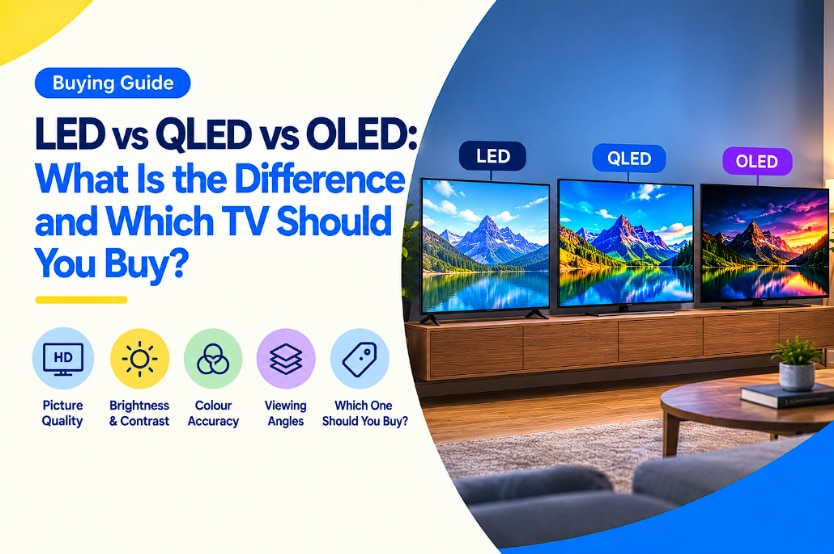
Quick Overview
- LED and QLED both rely on LCD panels with backlighting; OLED pixels light up on their own
- OLED gets you the deepest blacks and sharpest contrast, best for dark-room movie nights
- QLED usually runs brighter, so it holds up better in sunlit living rooms
- LED is still the dependable, energy-efficient pick for everyday watching
- Which one's "better" really comes down to your room's lighting and how you watch
LED vs QLED vs OLED: Complete Comparison
|
Feature |
LED |
QLED |
OLED |
|
Display Technology |
LCD panel with LED backlight |
LCD panel with LED backlight + Quantum Dot layer |
Self-lit pixels, no backlight |
|
Picture Quality |
Good, reliable colors |
Wider colour volume, more vibrant |
Richest colors, true blacks |
|
Brightness |
Moderate |
High, holds up well in bright rooms |
Slightly lower peak brightness |
|
Contrast |
Decent |
Strong, especially with local dimming |
Exceptional: pixel-level control |
|
Viewing Angles |
Wide |
Wide |
Excellent, minimal color shift |
|
Gaming |
Reliable |
Fast response, good for bright rooms |
Near-instant response, ideal for dark rooms |
|
Lifespan |
Long |
Long |
Slightly shorter due to organic materials |
What Is an LED TV?
An LED TV is really just an LCD television with rows of light-emitting diodes lighting it from behind. The panel itself doesn't produce light; the backlight does, and the liquid crystal layer in front controls how much gets through to form the picture.
It's been the workhorse of the TV market for years, and there's a reason for that. LED TVs sip less power, tend to last a long time without issue, and offer wide viewing angles, which matter more than people think if the couch isn't lined up dead-centre with the screen.
What Is a QLED TV?
QLED starts the same way as LED: an LCD panel and an LED backlight but adds a Quantum Dot filter layer between the backlight and the panel. Those tiny dots convert light into sharper, more accurate colour, which is why QLED sets tend to look noticeably more vivid, especially when you crank up the brightness.
You'll find QLED at pretty much every price point now, from Samsung's Neo QLED sets with Mini LED backlighting to more affordable options from Hisense and BPL. That quantum dot layer is what separates these from a plain LED set sitting next to it on the shelf.
What Is an OLED TV?
OLED throws out the backlight idea entirely. Each pixel makes its own light, which means each one can also switch off completely, and that's where OLED's black levels come from. Not a dimmed, backlit near-black. An actual off-pixel.
That same self-lit design is why OLED panels can be built so thin and why the viewing angle holds up so well no matter where you're sitting. LG's still the name most associated with this: their OLED C6 and G6 series are built entirely around this pixel-by-pixel lighting.
LED vs QLED vs OLED: Key Differences That Matter
Strip it down and the real difference is just how each one makes light. LED and QLED both push a backlight through liquid crystal: QLED just filters that light through quantum dots first for better colour. OLED skips the backlight step altogether and lets the pixels handle it themselves.
That one structural choice ripples through everything else. OLED's pixel-level control gives it the edge in contrast, since no backlight leaks into dark scenes the way it can with LCD-based panels. QLED tends to swing the other way, running brighter overall, which helps it cut through glare in a sunny room where OLED can start to look a little washed out.
I swapped a basic LED TV for a QLED one a couple of years back, mostly because my living room gets hit with afternoon sun. That was the upgrade I actually noticed day to day: no more squinting through a hazy screen trying to watch a cricket match at 4pm.
Which Display Is Better for Movies, Gaming and Everyday Viewing?
For a proper movie night with the lights down, OLED is tough to argue with. Those true blacks and pixel-level contrast make dark scenes feel a lot more three-dimensional than anything a backlit panel can manage.
Gaming's more of a toss-up. Both QLED and OLED do well, but OLED's near-instant pixel response gives it a slight edge for fast-paced titles, as long as you're playing somewhere dim or moderately lit. Crank the lights up, though, and QLED's extra brightness can actually make the action easier to track.
For the everyday stuff: news in the morning, background TV, and casual streaming with the lights on: QLED and standard LED both do the job well. LED in particular is still a perfectly solid choice if premium picture quality isn't really what you're chasing.
Which Is Better: LED, QLED or OLED?
There's no clean winner here: it really hinges on your room and your habits. QLED tends to win on brightness and colour punch, which suits a living room that gets a lot of daylight. OLED wins on contrast and black accuracy, which makes it the natural fit for a dedicated home theatre or a bedroom where you control the lighting. And LED just keeps doing what it's always done: reliable, efficient, and still a genuinely good picture for most everyday viewing.
Conclusion: Which TV Display Should You Choose?
There isn't one universal answer to which is better, LED QLED or OLED: it comes down to where the TV's actually going to live and how you plan to use it. Bright room, want punchy colour? QLED sets like Samsung's Neo QLED lineup or LG's QNED series are worth a look. Building a proper movie-night setup with the lights under control? OLED's contrast advantage is the kind of thing you notice within the first five minutes. And if you just want something dependable without paying for specs you won't use, LED still gets the job done. JioMart's smart buys section makes it easy enough to line these up side by side before you commit to one.
FAQs
Which is better, LED or OLED?
OLED generally offers better contrast and truer blacks thanks to its self-lit pixels, while LED remains more energy-efficient and budget-friendly for everyday viewing.
Which TV is better for eyes, OLED or QLED?
Both are comfortable for extended viewing, though OLED's lower blue-light emission and reduced flicker in dark scenes make it a slightly gentler option for long viewing sessions.
Which TV lasts longer, OLED or QLED?
QLED panels generally last longer because they don't rely on organic materials, while OLED panels, though still durable, can gradually lose brightness over many years of heavy use.
Which TV is safest for eyes?
QLED and OLED are both safe for regular viewing; choosing one with good ambient-light handling and enabling eye-comfort or low-blue-light modes matters more than the panel type itself.
Which TV is the best to buy right now?
It depends on your priorities: QLED suits bright rooms and vibrant everyday viewing, while OLED is the stronger pick for dedicated home theatre setups with controlled lighting.