


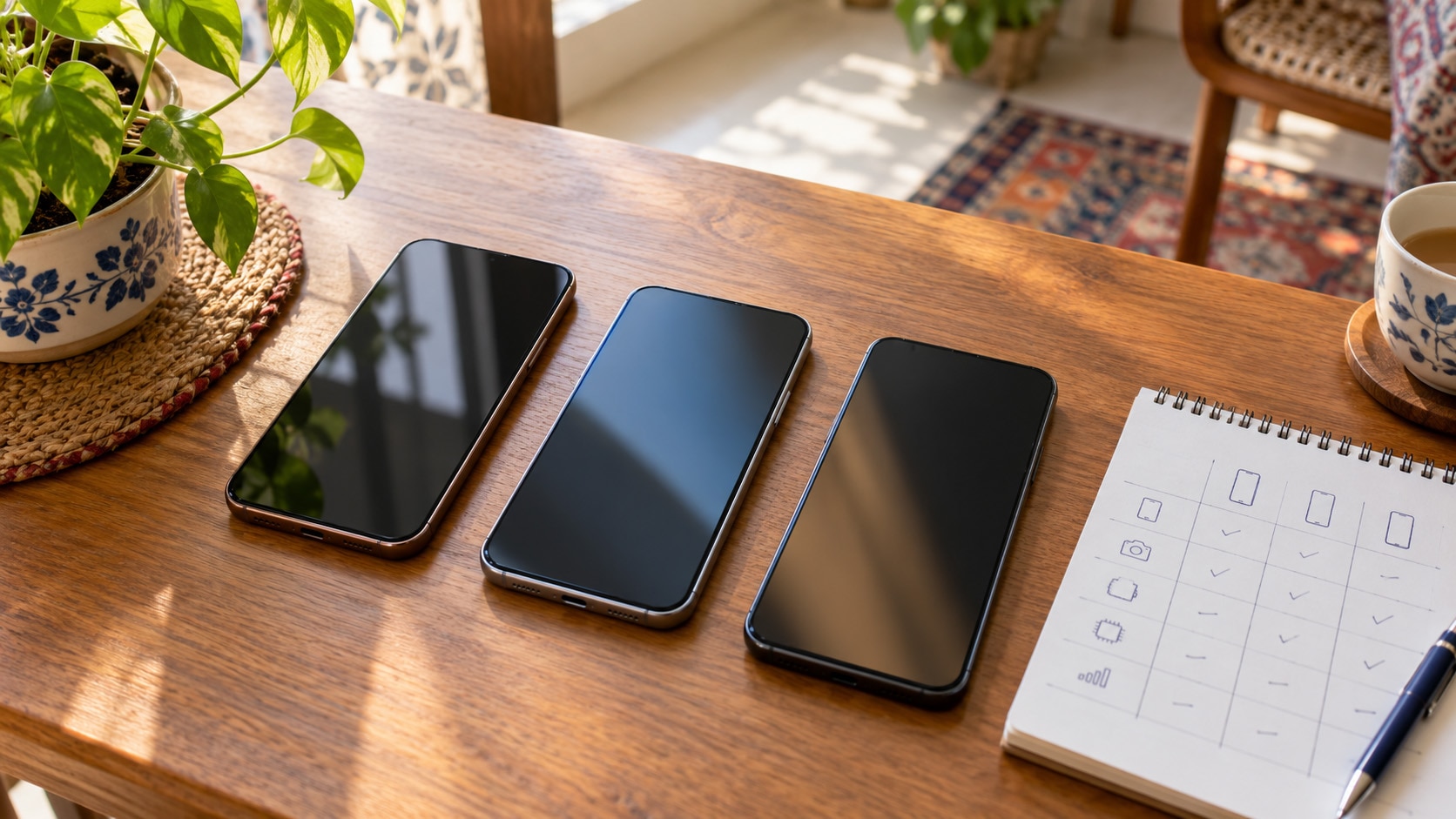
Read across one row at a time and fill it in for every phone on your shortlist.
Smartphone specs explained
| Spec | What it means | Good enough for most buyers | Watch out for |
|---|---|---|---|
| Processor (chip) | The brain of the phone; sets overall speed | A recent mid-range chip from a known chip maker | Speed in GHz alone; two chips at the same GHz can perform very differently |
| RAM | Short-term memory for running apps | 6 GB for everyday use; 8 GB if you game or multitask | "Virtual" or "expandable" RAM, which borrows storage and is slower |
| Storage | Space for apps, photos and videos | 128 GB; pick more if there is no memory card slot | 64 GB fills up quickly once apps update |
| Display | Screen type, size and refresh rate (how many times a second the picture updates, in Hz) | AMOLED or a good LCD, 90–120 Hz for smooth scrolling | High Hz on a dim or low-resolution screen |
| Camera | Megapixels (MP) and the number of lenses | One good main camera; extra lenses only if useful | Big MP numbers and 2 MP "depth" or "macro" lenses that add little |
| Battery | Battery size in mAh (milliamp-hours) | About 5,000 mAh lasts a full day for most people | Size alone; screen and chip affect how long it really lasts |
| Charging | Charging speed in watts (W) | 25–45 W is fast enough | A big watt figure with no charger in the box |
| Software updates | How many years of Android and security updates the brand promises | At least 3–4 years of security updates | No written update promise |
| Network and extras | 5G bands, water resistance (IP rating), headphone jack | 5G if you plan to keep the phone 3+ years | "Splash-proof" claims without a written IP rating |
Good-enough figures are general buying guidance, not legal standards. No Indian standard defines processor speed, RAM, refresh rate, megapixels or battery size, so brands may measure them differently.[R1]
What on the box is actually checked
These box details are fixed by Indian rules, so they mean the same for every brand.
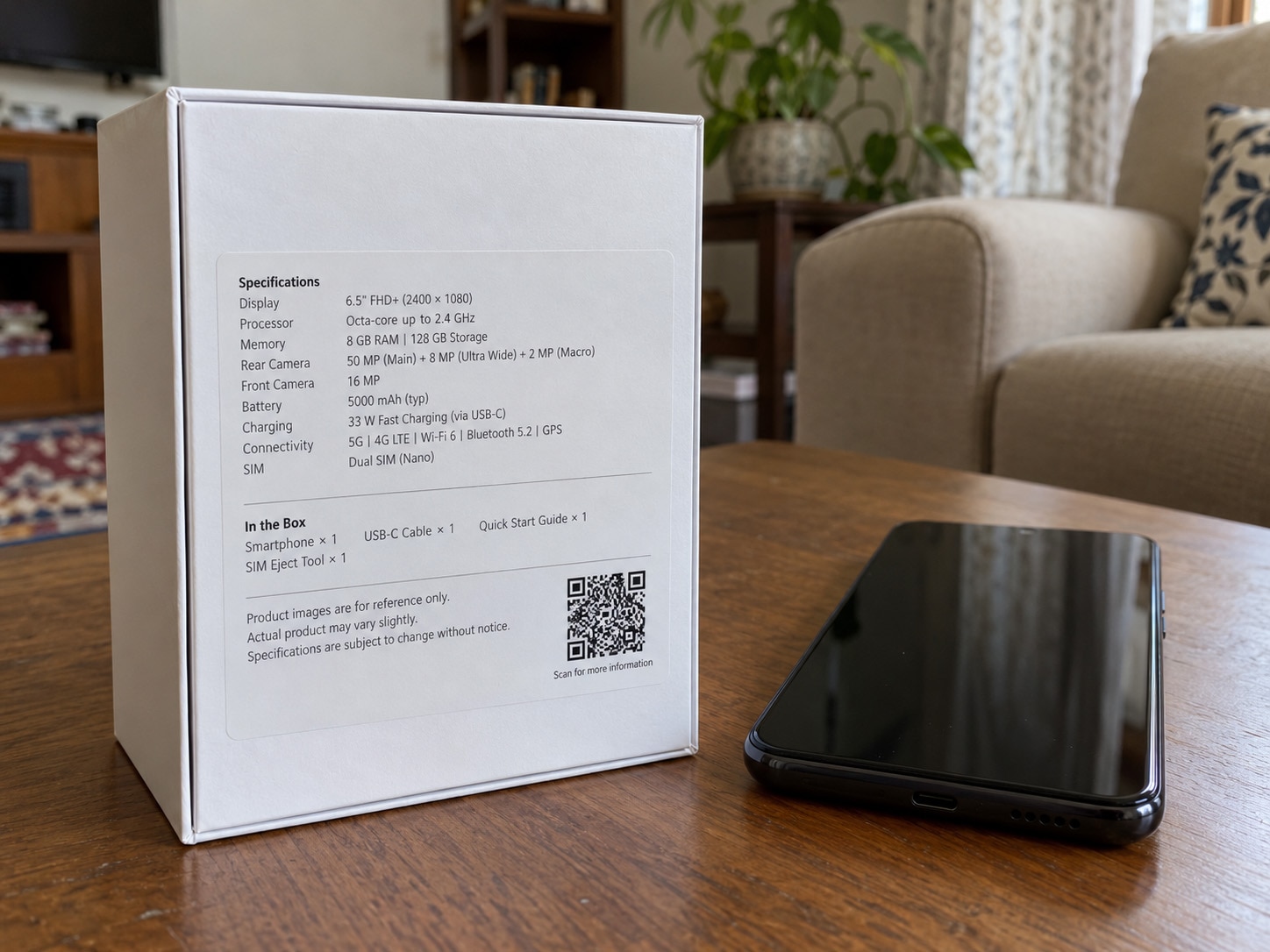
Box details you can trust
| Box detail | What to check |
|---|---|
| BIS (Bureau of Indian Standards) mark or the words "Self Declaration" | Should show an R-number (registration number) and the BIS website address |
| Safety standard number | Phones now list IS/IEC 62368 Part 1:2023; an older number is still allowed but means older approval |
| Maker or importer name and address | May sit behind a QR code on electronics, which is allowed |
| Month and year of manufacture | Tells you how old the stock is |
| Country of origin | Shown on imported phones; may mean where it was made or assembled |
Important pointers
- Enter the R-number on the BIS website to confirm it is real; the number of digits is not a test.
- The SAR (radiation) value must be shown at the point of sale; it is a safety figure, not a speed figure.[R4]
Which specs matter most for you
Match the phone to how you use it
| If you mostly… | Put first | Can compromise on |
|---|---|---|
| Call, chat and use UPI | Battery, update promise | Camera, refresh rate |
| Take photos and videos | Main camera, storage | Charging speed |
| Play games or stream | Processor, RAM, display | Number of camera lenses |
Quick comparison checklist
Run through this list for each phone, for example the Samsung Galaxy A07 (4 GB RAM, 64 GB), before you pay.
- Write each phone in a column and fill every row of the spec table.
- Cross out any phone below your must-have RAM or storage.
- Compare the written software update promise.
- Check the BIS mark, R-number and manufacture date on the listing or box.
- Pick the phone that meets "good enough" on every row, not the one that wins one row.
Compare phones on JioMart
On any JioMart product page, tap Compare on the product photo. Open a second product and do the same. Then tap Compare in the bar at the bottom to see them side by side.
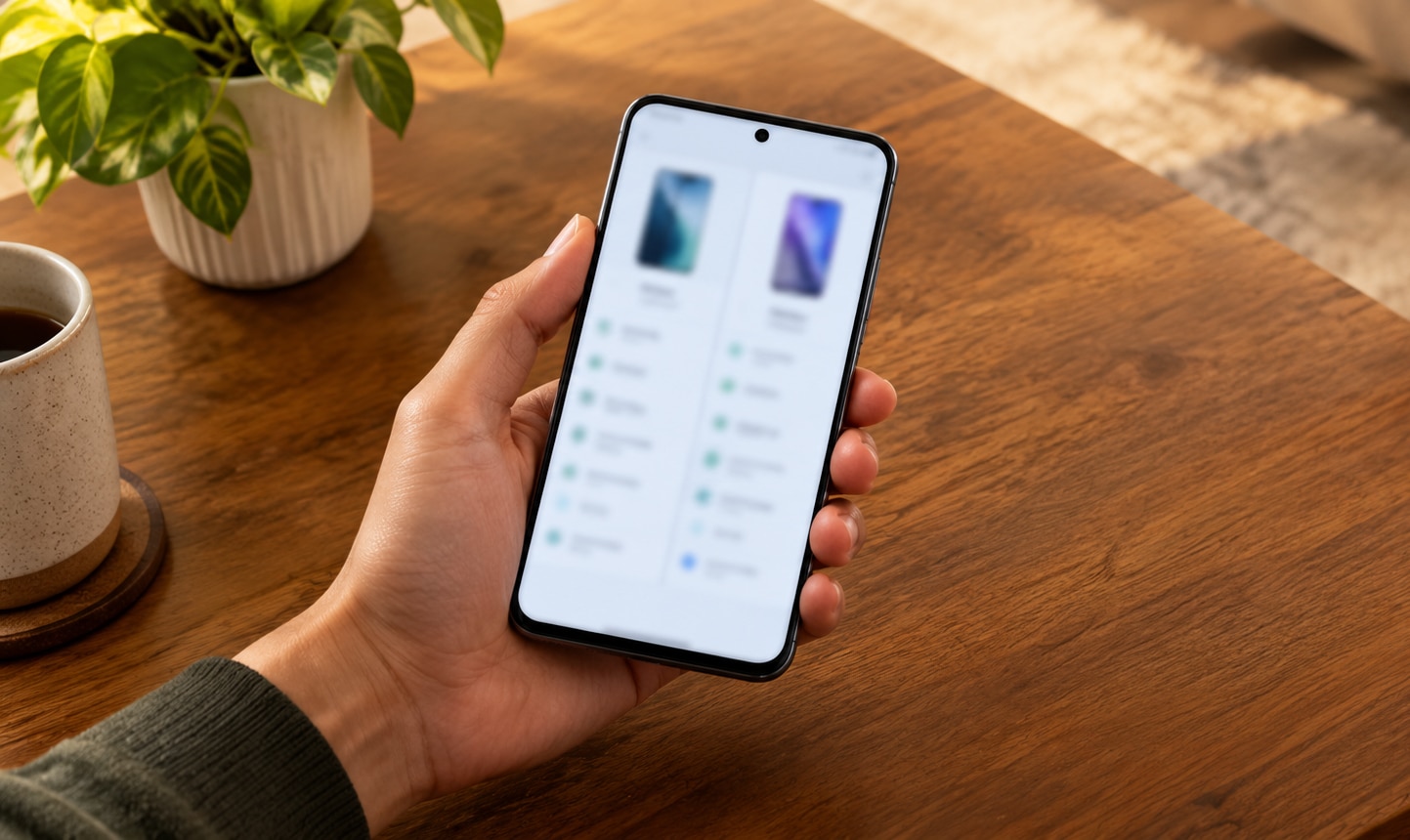
Compare two phones side by side: the Highlights row lines up RAM, storage, display, camera, processor and battery.
Shop on JioMart
- POCO C85 5G (8 GB RAM, 128 GB) — meets the "good enough" RAM and storage in this guide
- POCO C85x 5G (4 GB RAM, 128 GB)
- OPPO K14x 5G (6 GB RAM, 128 GB)
- Samsung F36 5G (6 GB RAM, 128 GB)
- Redmi 15C 5G (6 GB RAM, 128 GB)
Frequently Asked Questions
Is a phone with more megapixels always better?
No. Lens size, sensor size and the camera software decide photo quality. Look at sample photos and reviews.
Should I pay more for 5G?
If you will keep the phone three years or more, yes; a 4G-only phone may feel dated sooner.
Does a laptop or power bank carry the same BIS mark?
Yes. Laptops, tablets, power banks, chargers and wireless earphones are registered under the same BIS scheme and the same safety standard as phones.
References
R3Department of Consumer Affairs, Legal Metrology (Packaged Commodities) Rules, 2011, with amendments. consumeraffairs.gov.in
R4Department of Telecommunications, Tarang Sanchar portal, SAR limits for mobile handsets. tarangsanchar.gov.in
Disclosure
JioMart is a Reliance Retail platform. Products linked are examples, not recommendations. Prices and availability may change.